Crystal Types
Quartz Crystal Shapes Explained: Points, Clusters, Geodes, and Doubles
A quartz point on a shelf looks like a finished object. It isn't. It's a paused process, a record of hot mineral-rich water, slow cooling, and a pocket in the rock that gave the crystal just enough room and just enough time.
Most of what we call "quartz shapes" comes down to three variables: how much space the crystal had, how quickly the silica-bearing fluid delivered material, and whether the crystal stayed anchored to its bedrock or broke free and kept growing. Learn to read those three things and a cluster on a dealer's table stops being just a pretty object. It starts telling you where it came from.
The six-sided rule underneath everything
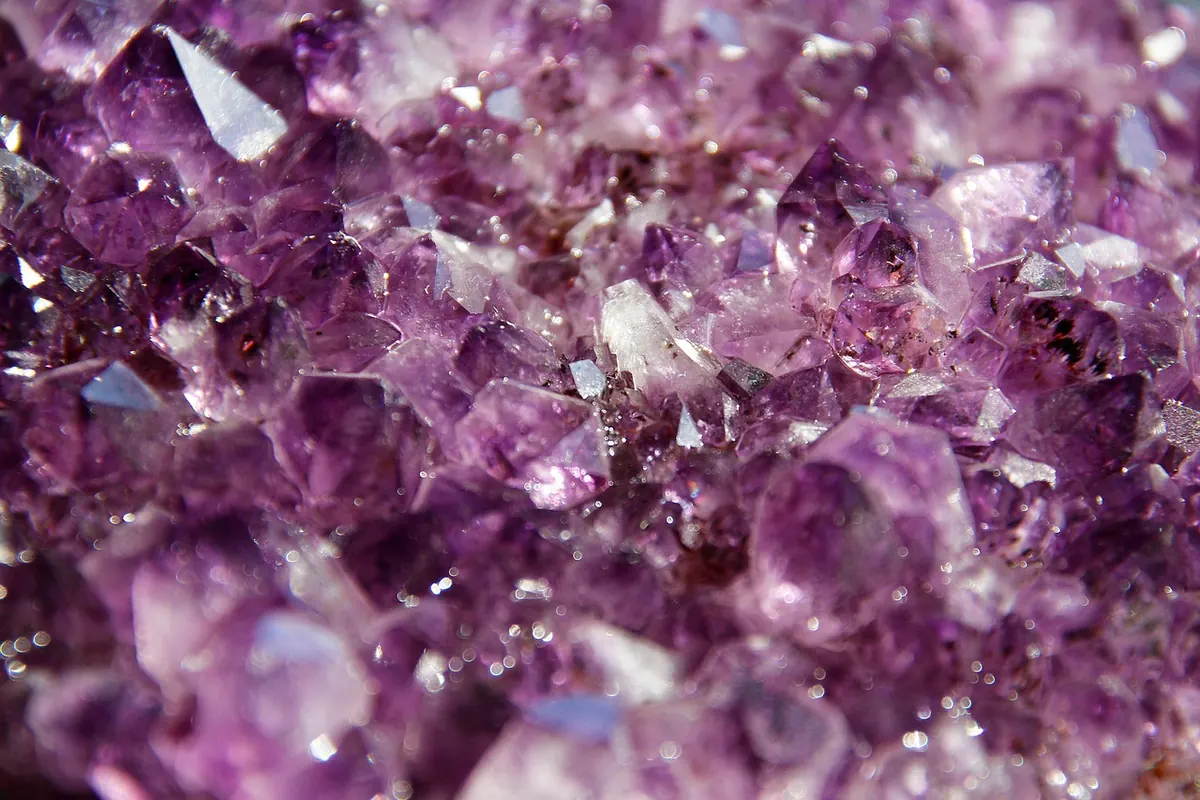
Quartz is silicon dioxide, and it is stubborn about its internal geometry. Under ordinary conditions it builds a six-sided prism capped with pyramid-like termination faces. Crowd it, starve it of fluid, or let it grow against other crystals and it will distort, but the underlying hexagon usually shows somewhere if you look.
Two growth directions explain most of the variety you'll see:
- Axial growth lengthens the prism, producing long, slender points.
- Lateral growth widens it, producing stubby, fat crystals with broad faces.
The balance between those two, plus the shape of the cavity, produces everything else in this guide. Slow, steady growth in a roomy pocket tends to give clear, well-formed crystals. Fast, crowded growth gives cloudy masses with small, jumbled points fighting for space.
Points: the single-terminated crystal
A point is a crystal that grew attached to rock at one end and terminated freely at the other. Almost every point has the same anatomy: a body of long prism faces, a set of angled termination faces at the tip, and a rough base where it broke or was pried away from the host rock.
Reading the tip
Termination faces are the crystal's fingerprint. If three large faces meet at the tip, that's a classic rhombohedral termination. If six smaller ones cluster around the point, growth was more even. A tip that looks lopsided or flat-topped usually means the crystal grew into a wall or another crystal and stopped.
Reading the sides
Run a fingernail sideways across a prism face. You should feel fine, closely spaced horizontal lines, like tiny stairs. Those striations are perpendicular to the length of the crystal and are one of the most reliable ways to tell quartz from glass or a lookalike. Glass is smooth and often has tiny round bubbles inside; quartz striations are regular and run the same way on every face.
Proportions tell you about speed. Long, thin points grew fast along the axis, often in a narrow cavity. Stubby, wide points grew slowly, with plenty of lateral room. Neither is better, but a well-proportioned point with a clean tip is the one collectors tend to keep.
Clusters: many points, one base
A cluster forms when several crystals nucleate on the same surface and grow together. That surface might be a plate of granite, a vein wall, or the remains of an older quartz mass. The result is a group of points sharing a base, often at slightly different angles because each one started with its own orientation.
Clusters are graded by their weakest link. A magnificent arrangement of tips means little if the base is a crumbling crust. Look for:
- Intact tips across the largest faces, not just the ones facing the camera.
- A sound attachment where each point meets the group.
- Consistent clarity, or an intentional contrast between milky and clear points.
- No glue lines around the base. Assembled clusters exist, and a thin pale ring or a suspiciously flat cut at the bottom is the giveaway.
When cleaning a cluster, skip the ultrasonic bath and the household acids. Lukewarm water, a soft brush, and patience will lift most clay and iron staining without loosening the points.
Geodes and druzy: growth pointing inward
A geode is a hollow rock lined with crystals. The story starts with a cavity — often a rounded nodule in volcanic rock or a hollow in limestone — that filled slowly with silica-bearing water. Crystals grew inward from the walls, feeding on fluid that percolated through the shell. Cut one open and the points face the centre of the void.
Druzy (or druse) is the same process at a smaller scale: a continuous crust of tiny crystals coating a surface. A geode can be lined with druzy, with large points, or with both, depending on how the chemistry changed over time.
Two practical notes. First, a solid nodule with no cavity inside is not a geode; it's a nodule, and it's still worth keeping, just for different reasons. Second, geode shells vary enormously in thickness. A thin one cracks under a tap from a chisel, so score a line around the middle and work gradually if you plan to open one yourself.
Doubles and floaters
A double-terminated crystal has points at both ends, which means it grew without being attached at either one. That doesn't require floating in mid-air. Many doubles grow in soft clay or mud, where a crystal detaches from its base, settles, and continues growing in a new direction. Others form in open pockets where the crystal is supported by loose material rather than fused rock.
The result is symmetry that single points rarely achieve. A true double with clean terminations at both ends is prized precisely because the conditions that produce it are uncommon: the crystal needs freedom on all sides for a long stretch of time. Check both tips for wear. A double that has rolled around in a riverbed usually shows rounded edges, while one that grew undisturbed stays sharp.
Other shapes worth knowing
Once you can read points, clusters, geodes, and doubles, these are the forms that will catch your eye next:
- Scepters: a second, smaller crystal has grown on top of an older one, like a cap on a staff.
- Phantoms: a ghostly outline inside the crystal marks an earlier growth stage, usually traced by clay or iron.
- Gwindels: twisted, flattened crystals, mostly from Alpine pockets, that look slightly bent on purpose.
- Twins: two crystals growing through each other at a fixed angle, sometimes producing a shallow V shape.
- Tabular and elestial: flattened or heavily stepped growth, created when the crystal kept starting new layers instead of extending.
What to check before a crystal follows you home
Whether you're buying, swapping, or just picking something up on a beach, a quick routine will save you from most disappointment:
- Turn the piece over. The base tells you more about condition than the tip does.
- Run a fingernail across a side face to feel for striations.
- Look along each tip at a low angle in good light; chips hide until the light rakes across them.
- Check for repair lines, glue, and mismatched colour where two pieces meet.
- Ask what it came out of — a pocket, a riverbed, a nodule. The answer changes how you should clean and store it.
- Hold it. Weight and cold tell you whether you're looking at solid quartz or something hollow or imitation.
Shape is the part of a quartz crystal you can read without any equipment. Spend a few minutes with a point, a cluster, and a geode side by side, and the vocabulary stops being abstract. After that, every new piece arrives with its own small history already written across the faces.
Photo: Dieter444 / Pixabay
Related Articles